
We manufacture battery materials processing equipment for grinding, screening, mixing, feeding and conveying cathode materials, anode materials and conductive additives.
Equipment can be customized to meet specific particle size, production capacity and material purity requirements, with options for wear-resistant liners, grinding media and enclosed powder handling.
Processing Capabilities
- Fine Grinding & Particle Size Reduction
- Precision Screening & Oversize Removal
- Powder Mixing & Blending
- Controlled Feeding & Enclosed Conveying

Battery Materials We Process
Our equipment is suitable for grinding, screening and handling a wide range of battery materials, including cathode powders, anode powders, conductive additives and precursors. Equipment configurations are based on material hardness, particle size, flowability and purity requirements.

LFP Cathode Materials
Grinding, screening and removal of oversized particles, with particular attention to particle size distribution and material contamination.

NCM Cathode Materials
Fine powder screening and enclosed material transfer, with product contact materials selected according to purity requirements.

Graphite Anode Materials
Screening, oversized particle removal and controlled conveying of natural and synthetic graphite powders.

Conductive Carbon Materials
Controlled feeding, powder screening and enclosed handling of low-density, dust-prone and easily agglomerated materials.

Silicon-Based Anode Materials
Grinding and screening configurations based on material hardness, particle morphology and target particle size.

Battery Material Precursors
Screening and powder handling equipment selected according to particle size, moisture content and processing requirements.
Challenges in Battery Powder Processing
Battery powder processing requires precise particle size control, low contamination and stable material flow. Common challenges include powder agglomeration, screen blinding, equipment wear, metallic contamination and dust leakage.
Particle Size Control
Grinding parameters, grinding media and screen openings are selected according to the required particle size distribution. Processing results can be verified against specified D50, D90 and oversize limits.
Powder Agglomeration
Fine powders may agglomerate due to moisture, electrostatic effects and interparticle forces. Ultrasonic screening and suitable deagglomeration methods help improve powder dispersion and reduce screen blinding.
Material Contamination
Wear from grinding media, liners and product contact components may introduce unwanted impurities. Suitable contact materials and wear-resistant components are selected according to contamination limits.
Dust and Moisture Control
Enclosed feeding, sealed connections and suitable dust extraction arrangements help reduce powder leakage and exposure to the surrounding environment. Moisture-sensitive and combustible powders require application-specific controls.
Battery Material Processing Flow
A battery powder processing system may include controlled feeding, grinding, screening, mixing and enclosed conveying. Individual processing stages can be configured independently or connected to existing production equipment according to the material and production requirements.
01 Feeding
02 Grinding
03 Screening
04 Mixing
05 Conveying
| Processing Stage | Function | Recommended Equipment |
|---|---|---|
| Feeding | Controlled and consistent material supply | Vibrating Feeder, Vacuum Feeder |
| Grinding | Particle size reduction | Single Tube or Double Tube Vibration Mill |
| Screening | Oversize removal and particle size separation | Ultrasonic Vibrating Screen, Centrifugal Sifter |
| Mixing | Blending of compatible powder components | Powder Mixer |
| Conveying | Enclosed transfer between processing stages | Vacuum Conveyor, Tube Chain Conveyor |
Grinding and mixing are optional processing stages. The final equipment configuration depends on the material properties and required production process.
Battery Materials Processing Equipment
Our battery materials processing equipment range covers powder grinding, fine screening and enclosed material handling. Equipment specifications, contact materials, operating parameters and inlet and outlet connections can be configured for individual production requirements.
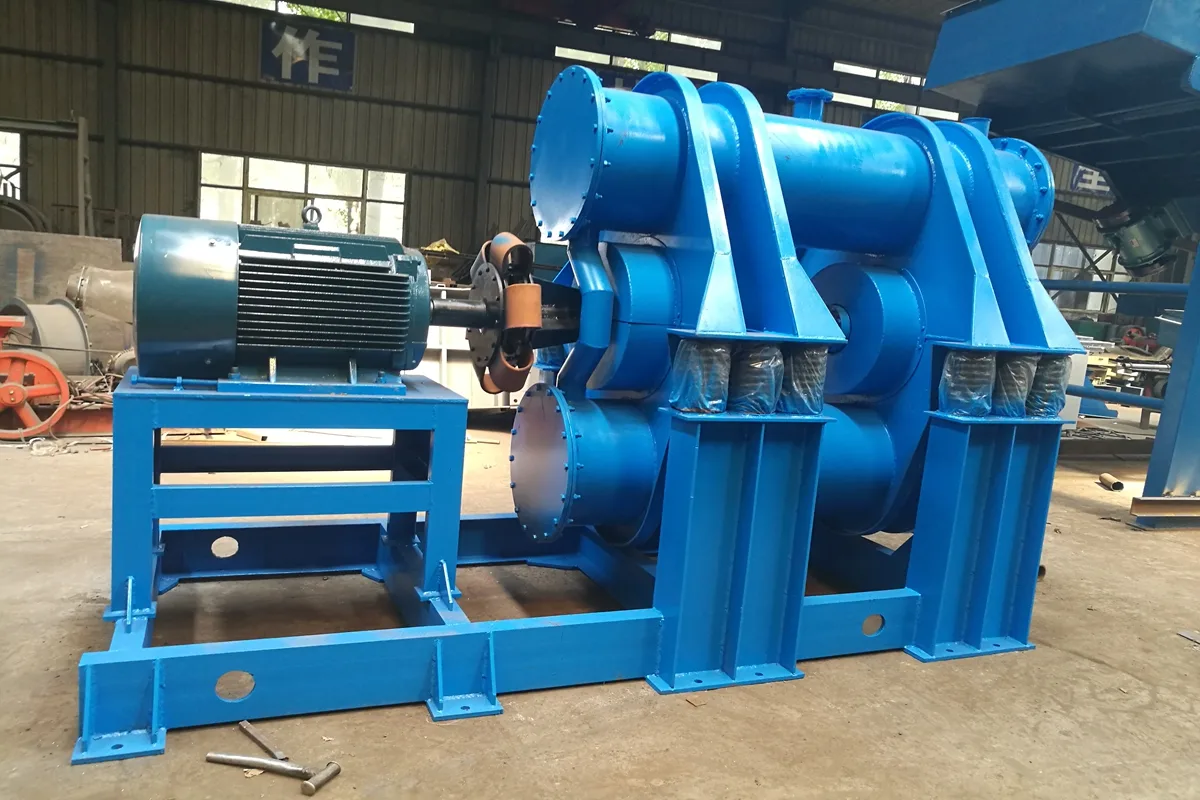
Double Tube Vibration Mill
Uses vibratory grinding media to reduce particle size through impact and attrition. Suitable for battery materials where grinding performance and contamination limits have been verified.
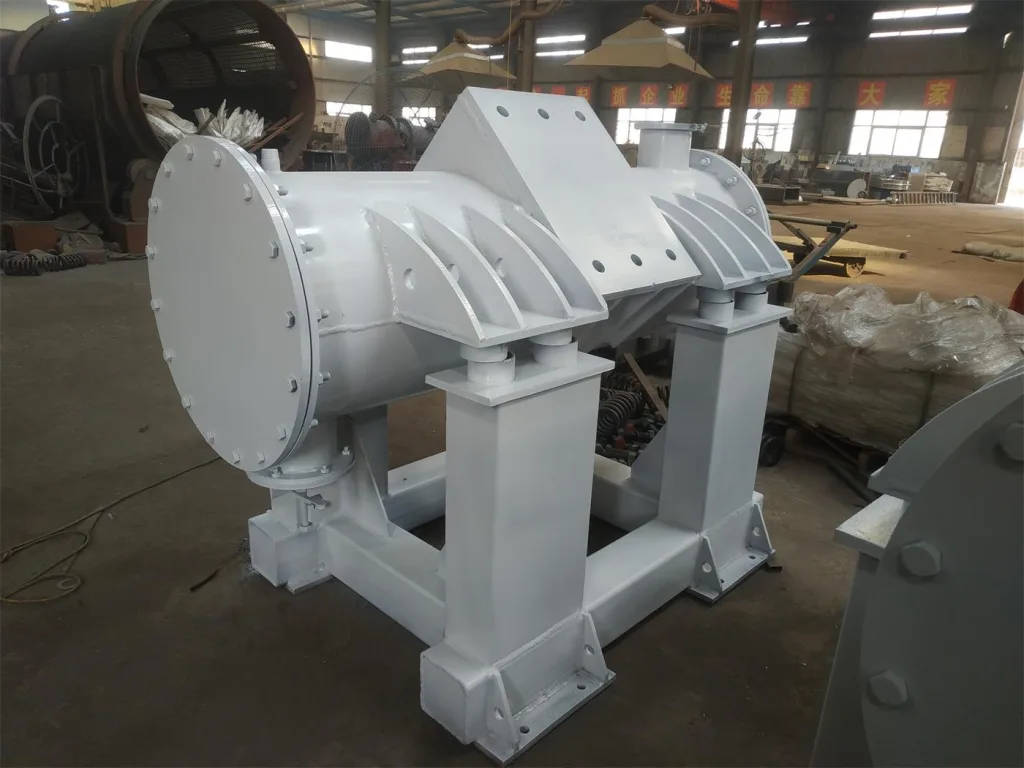
Single Tube Vibration Mill
Designed for powder grinding and material processing applications. Grinding media and operating parameters can be selected according to material hardness and target fineness.
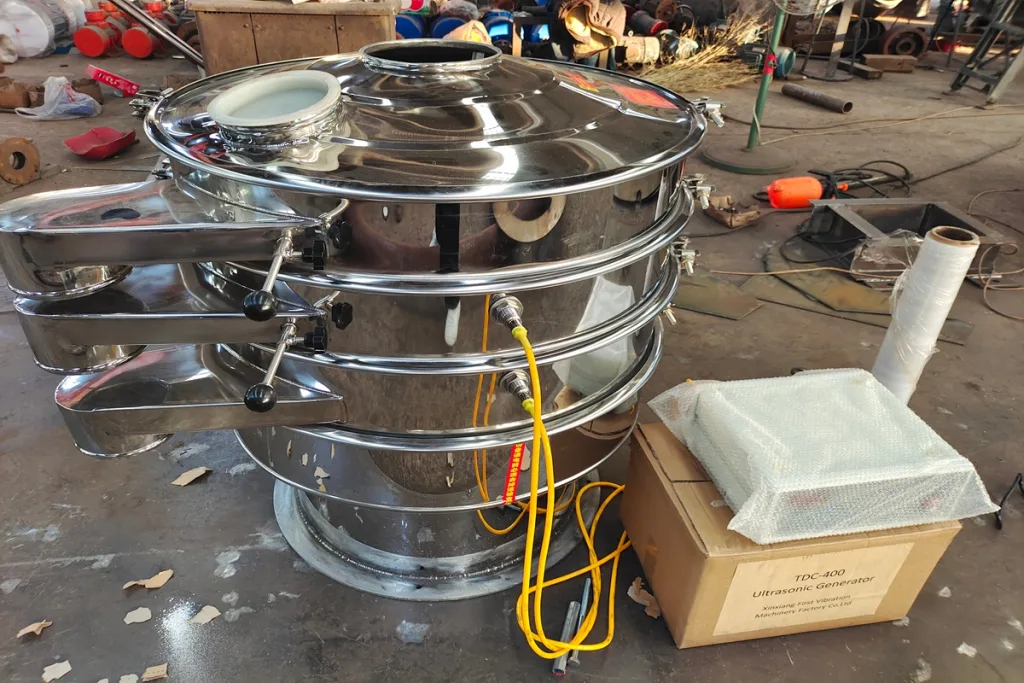
Ultrasonic Vibrating Screen
Combines mechanical vibration with ultrasonic screen excitation to reduce mesh blinding during fine battery powder screening.

Centrifugal Sifter
Separates oversized particles and disperses loose agglomerates in compatible powders using a rotating screening mechanism.
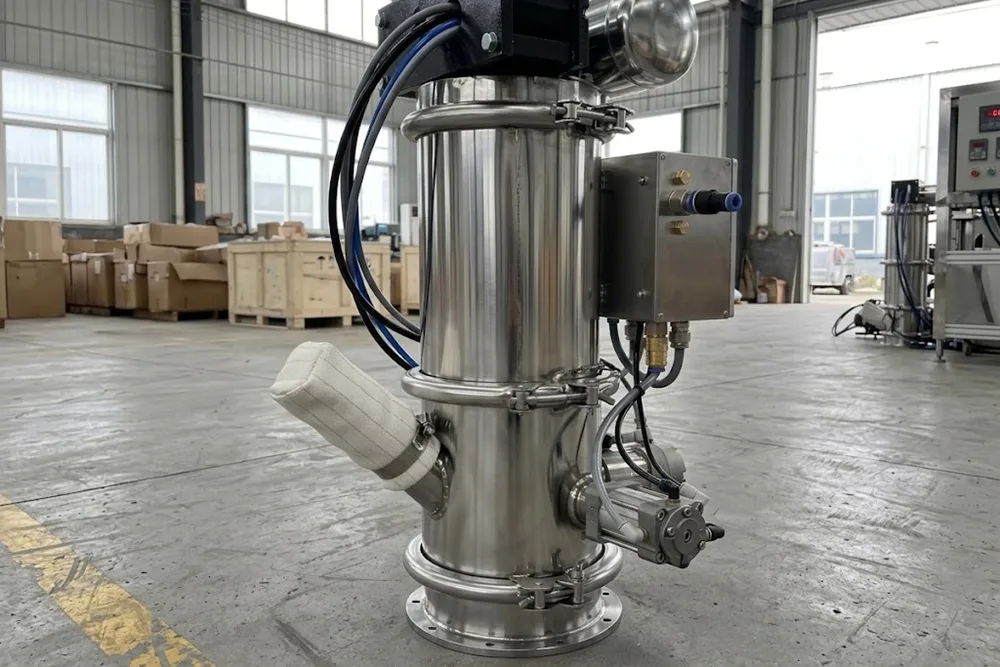
Vacuum Feeder
Transfers powders through enclosed pipelines, reducing manual material handling and exposure during feeding and transfer operations.
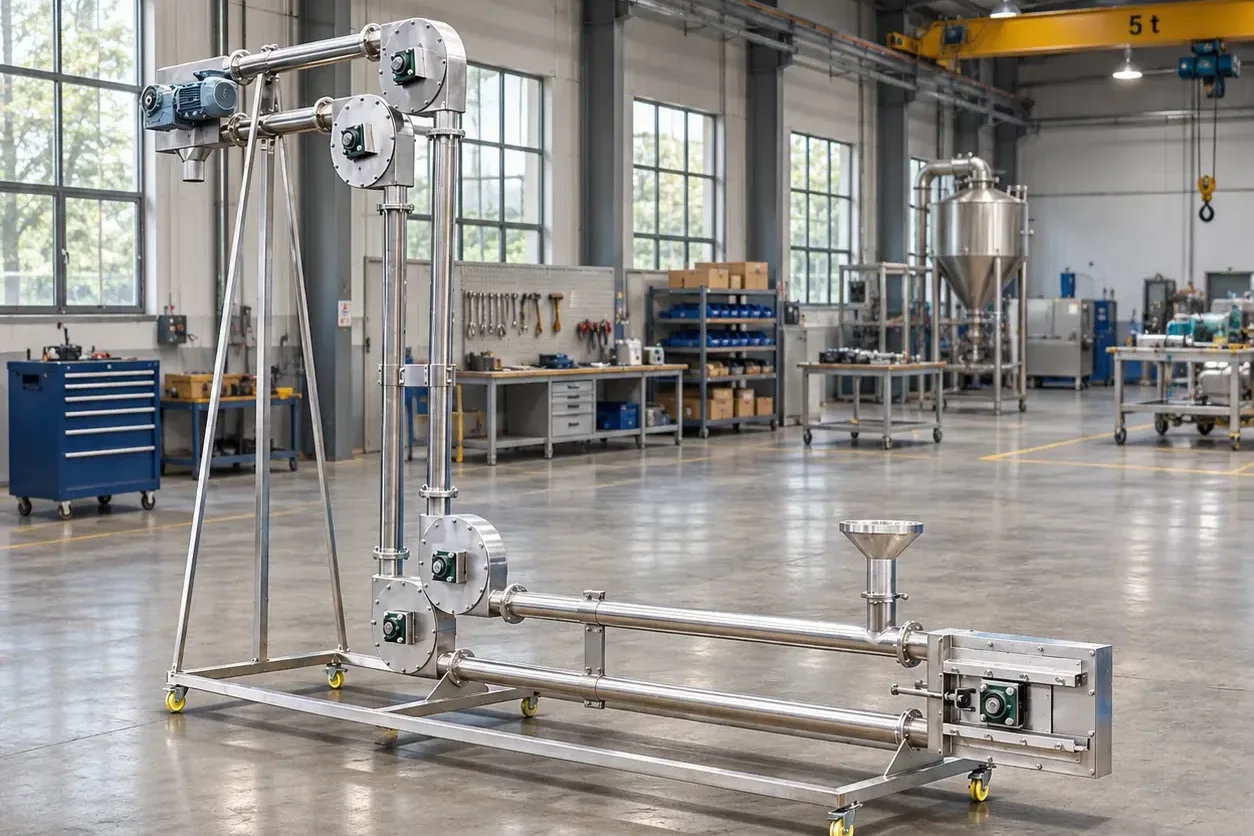
Tube Chain Conveyor
Provides enclosed bulk material transfer along horizontal, inclined or vertical conveying routes, depending on material properties and plant layout.
Processing Solutions for Cathode and Anode Materials
Battery materials differ in hardness, particle morphology, bulk density and contamination sensitivity. Processing equipment is therefore configured according to the specific material rather than using a single standard arrangement for all battery powders.
Cathode Powder Grinding and Screening
For LFP, NCM and other cathode powders, grinding and screening equipment can be configured according to feed particle size, target fineness and purity requirements. Particular attention is given to grinding media wear, oversized particle removal and sealed connections between processing stages.
| Configuration | Recommended Solution |
|---|---|
| Grinding | Single or Double Tube Vibration Mill |
| Screening | Ultrasonic Vibrating Screen |
| Powder Transfer | Vacuum Feeder |
| Design Considerations | Particle size, contact materials, contamination limits |
Graphite and Anode Powder Processing
Graphite powder processing systems can incorporate fine screening, controlled feeding and enclosed conveying equipment to remove oversized particles and maintain consistent material transfer. Where further particle size reduction is required, grinding conditions should be evaluated to avoid unnecessary changes to particle morphology.
| Configuration | Recommended Solution |
|---|---|
| Screening | Ultrasonic Vibrating Screen or Centrifugal Sifter |
| Feeding | Vibrating Feeder |
| Powder Transfer | Vacuum Conveyor or Tube Chain Conveyor |
| Design Considerations | Particle morphology, screening accuracy, material containment |
Conductive Additive Handling
Conductive carbon powders typically have low bulk density and a tendency to agglomerate. Suitable feeding, screening and mixing equipment can be configured to support consistent powder handling. Equipment selection should consider flowability, agglomeration, material retention and combustible dust hazards.
| Configuration | Recommended Solution |
|---|---|
| Feeding | Vacuum Feeder or Suitable Controlled Feeder |
| Screening | Selected Through Material Evaluation |
| Mixing | Application-Specific Powder Mixer |
| Design Considerations | Bulk density, feeding stability, dust containment |
Contamination Control in Battery Powder Processing
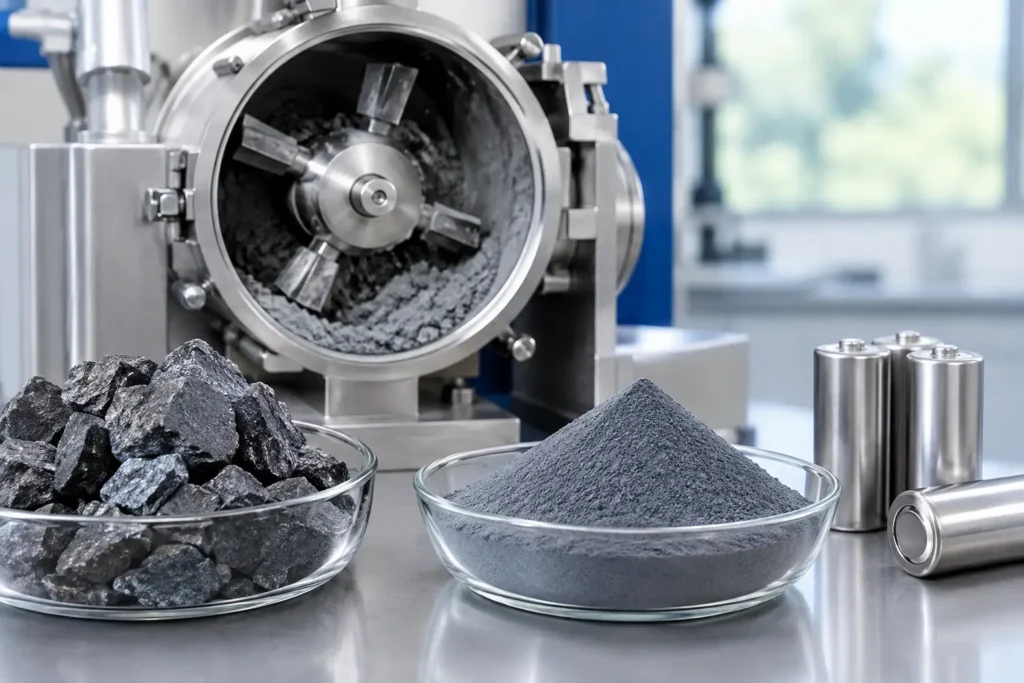
Contamination control is an important consideration when selecting battery material grinding and screening equipment. Grinding media, liners, product contact surfaces and sealing components should be selected according to material compatibility and allowable impurity levels.
01 / Grinding Media and Liner Selection
Grinding media and liners can be selected according to material hardness, target particle size and allowable contamination levels. Ceramic media and liners may be considered where metallic contamination must be limited.
02 / Product Contact Materials
Product contact materials are selected according to powder characteristics and purity requirements. Non-metallic contact components or protective liners may be considered for metal-sensitive applications.
03 / Sealed Feeding and Conveying
Enclosed inlets, outlets, pipelines and suitable sealing components help reduce external contamination and powder leakage during material transfer.
04 / Equipment Cleaning and Material Changeover
Accessible product contact areas, removable components and suitable cleaning arrangements help reduce material retention and cross-contamination between production batches.
How to Select Battery Materials Processing Equipment?
The selection of battery materials processing equipment depends on material properties, feed size, target particle size, required throughput and purity requirements. The table below provides equipment recommendations for different processing needs and key parameters to consider during selection.
| Processing Requirement | Recommended Equipment | Selection Parameters |
|---|---|---|
| Fine powder grinding | Vibration Mill | Feed size, target D50/D90, hardness |
| Oversized particle removal | Ultrasonic Vibrating Screen | Screen opening, throughput, oversize content |
| Screening agglomerated powders | Ultrasonic Screen or Centrifugal Sifter | Agglomeration, flowability, moisture |
| Multi-component powder blending | Powder Mixer | Formulation, batch size, mixing uniformity |
| Enclosed powder feeding | Vacuum Feeder | Conveying distance, lifting height, bulk density |
| Continuous powder transfer | Tube Chain Conveyor | Capacity, conveying route, abrasiveness |
Technical Information Required for Equipment Selection
The following information helps determine suitable equipment models, grinding media, screen specifications, conveying methods and system configurations.
| Parameter | Required Information |
|---|---|
| Material | Material name and composition |
| Feed Particle Size | Initial particle size and distribution |
| Target Particle Size | Required fineness, D50, D90 or screen opening |
| Processing Capacity | Required throughput in kg/h or batch capacity |
| Bulk Density | Loose or tapped bulk density |
| Moisture Content | Material moisture and moisture sensitivity |
| Contamination Limits | Allowable metallic and other impurities |
| Installation Layout | Available space and equipment connections |
| Operating Conditions | Temperature, humidity and dust safety requirements |
Providing representative material samples and particle size data can help establish a more accurate equipment configuration.
Engineering Design and Customization
Guofeng provides customized battery powder processing equipment based on your material properties, production capacity and plant layout. We offer flexible configurations for equipment dimensions, grinding media, contact materials, screen specifications, sealing and system integration.
| Customization Option | Available Configuration |
|---|---|
| Grinding Configuration | Grinding chamber size, media and liners |
| Screening Configuration | Screen openings, screen decks and mesh cleaning systems |
| Product Contact Materials | Application-specific contact materials and wear protection |
| Feeding and Discharge | Inlet and outlet dimensions, positions and connections |
| Sealing and Dust Control | Sealing arrangements and dust extraction connections |
| System Integration | Equipment layout, electrical controls and process connections |
Applications involving strict contamination limits, moisture-sensitive materials or combustible dust require additional technical evaluation before the equipment configuration is finalized.
Material Testing & Equipment Configuration
Grinding Equipment Configuration
Grinding chamber, media, liners and operating parameters selected according to material properties.
Screening and Powder Handling Configuration
Screen specifications, feeding arrangements and enclosed transfer connections selected according to production requirements.
For battery materials with specific particle size, purity or handling requirements, material evaluation is recommended before final equipment selection.
The evaluation may include feed particle size, target fineness, grinding performance, screening throughput, material retention and contamination risks. The results provide a basis for equipment selection and process configuration.
Frequently Asked Questions
What equipment is used in battery materials processing?
Battery materials processing equipment typically includes grinding mills, fine screening machines, powder mixers, feeders and enclosed conveying systems. Equipment selection depends on the material type, production stage, target particle size and purity requirements.
Can vibration mills be used for cathode and anode materials?
Vibration mills can be used for particle size reduction of selected cathode and anode materials. Material hardness, particle morphology, target fineness and contamination limits should be evaluated before selecting the grinding media and operating parameters.
How do you control particle size in battery powders?
Particle size can be controlled through grinding time, grinding media, operating parameters and screening specifications. Particle size analysis is used to verify the resulting distribution against the required D50, D90 and oversize limits.
How can metal contamination be reduced during battery powder processing?
Metal contamination can be reduced by selecting suitable grinding media, protective liners and product contact materials. Regular inspection of wear components, equipment cleaning and enclosed material transfer also help control contamination.
Which screening equipment is suitable for fine battery powders?
Ultrasonic vibrating screens are commonly considered for fine powders prone to screen blinding. Centrifugal sifters may be suitable for compatible powders requiring oversize removal and loose agglomerate dispersion. Selection depends on particle size, flowability and required throughput.
Can battery materials processing equipment be customized?
Yes. Equipment dimensions, grinding media, contact materials, screen openings, sealing arrangements and conveying connections can be configured according to material properties, production capacity and installation requirements, subject to technical feasibility.
Get a Battery Materials Processing Solution
Tell us about your material, feed particle size, target fineness and required production capacity. Our engineering team can recommend suitable equipment and processing configurations based on your application requirements.
Include the material name, required capacity, feed and target particle size, contact details and project requirements in your inquiry.