
Sidewall belt conveyor design requires careful consideration of the conveying angle, sidewall height, cleat configuration, and conveying capacity. For bulk materials such as ore, aggregates, and coal, particle size, bulk density, lift height, and available installation space all affect the equipment configuration. A well-designed conveyor must meet the required throughput while reducing material rollback, spillage, and cleat deformation.
This guide covers the key steps in sidewall belt conveyor design, including incline angle selection, sidewall height, cleat configuration, and capacity calculation. These factors help you select a conveyor suited to your material and site conditions.
Sidewall Belt Conveyor Design: Components and Working Principle
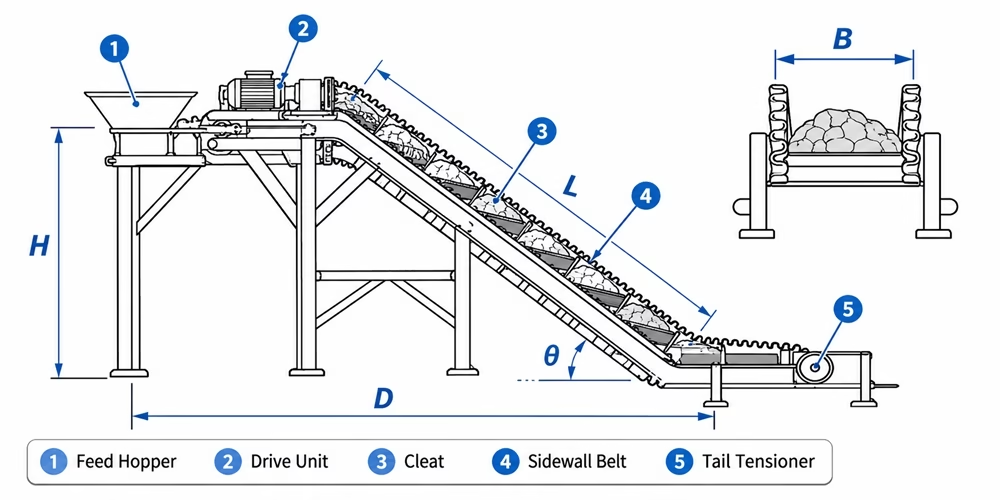
A sidewall belt conveyor uses corrugated sidewalls along both edges of the belt to contain material and transverse cleats to prevent it from sliding backward. Together, these components allow bulk materials to travel upward at steep angles. This arrangement is particularly suitable for bulk material handling projects with a substantial lift height and limited installation space.
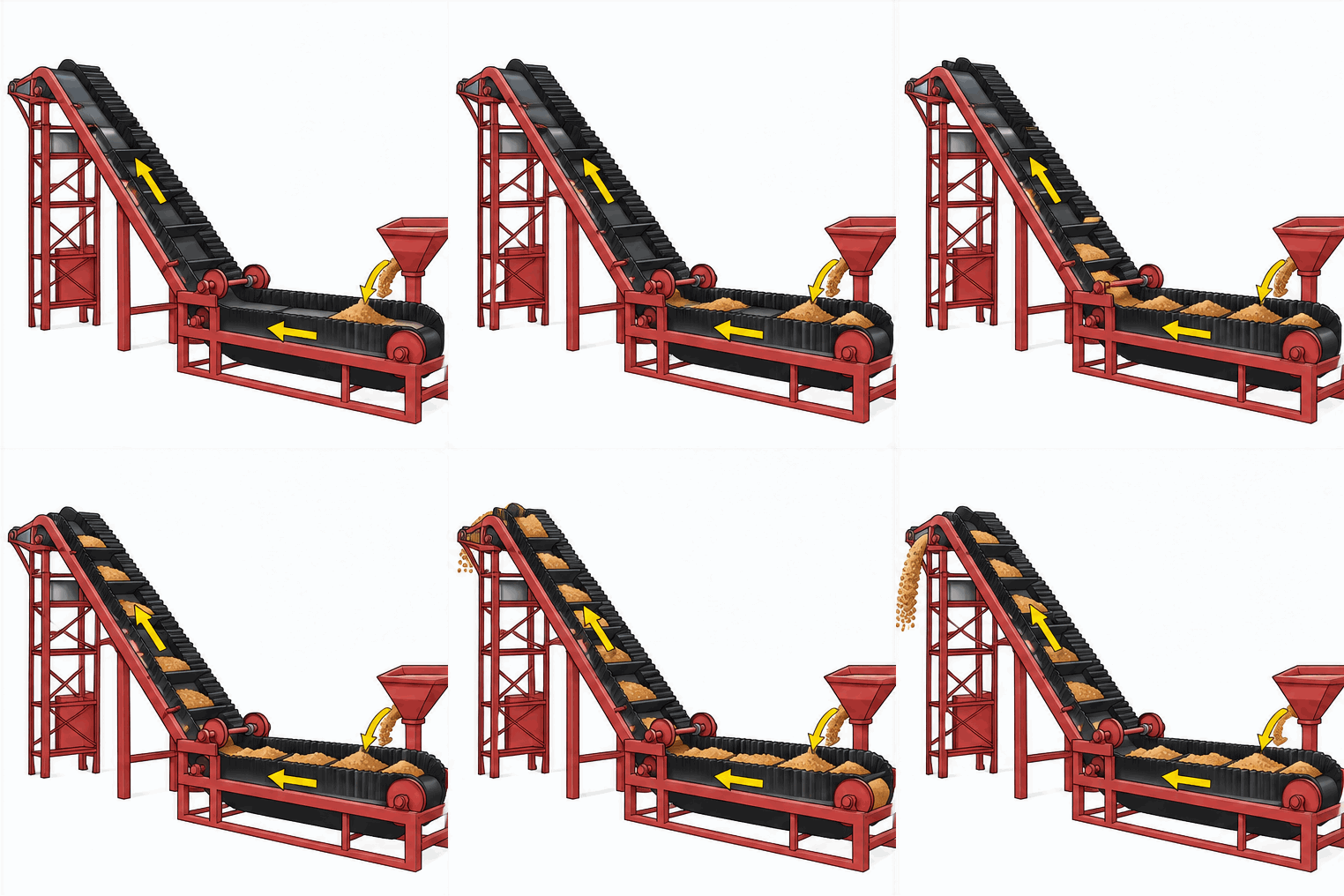
What Are the Main Components of a Sidewall Belt Conveyor?

| Main component | Primary function |
|---|---|
| Base belt | Carries the material, transmits the driving force, and provides the mounting surface for the sidewalls and cleats. |
| Corrugated sidewalls | Contain material along the belt edges while flexing as the belt passes around pulleys. |
| Transverse cleats | Divide the carrying area into pockets and support the material, reducing rollback on steep inclines. |
Where Are Sidewall Belt Conveyors Used?
Sidewall belt conveyors are commonly used to elevate bulk materials in mining, aggregate processing, coal handling, and cement production. They are particularly suitable when:
A substantial lift height is required
Material needs to move continuously from a lower level to a higher discharge point.
Installation space is limited
The site cannot accommodate a long conventional inclined belt conveyor.
Fewer transfer points are needed
Reducing intermediate transfer equipment can help limit spillage and dust generated during material transfers.
How Does Belt Construction Affect the Conveying Angle?
Different belt constructions suit different conveying angles and material conditions. Selection should account for more than the angle alone: material rollback, lateral spillage, and available installation space also matter.
How Do the Main Conveyor Belt Types Compare?
| Belt type | Main construction | How it retains material | Typical applications |
|---|---|---|---|
| Plain belt | Smooth carrying surface | Relies mainly on friction between the material and the belt | Horizontal conveying and shallow inclines |
| Profiled belt | Raised patterns, such as chevrons or V-shaped profiles | Improves grip between the material and the belt | Bulk material conveying on inclines within the belt’s suitable operating range |
| Cleated belt | Transverse cleats fitted to the belt surface | Uses cleats to resist material rollback | Inclined conveying and material elevation |
| Corrugated sidewall belt | Corrugated sidewalls combined with transverse cleats | Forms individual material pockets between the sidewalls and cleats | Steep inclines and vertical lifting |

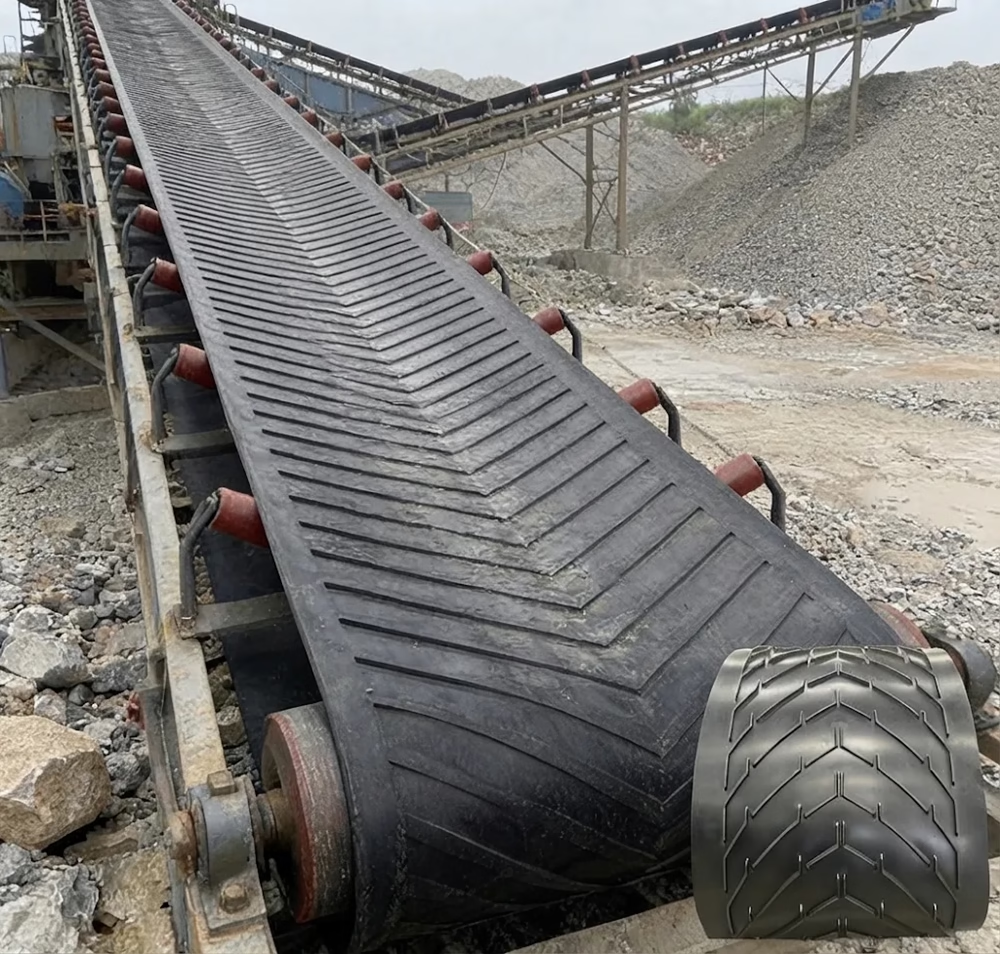
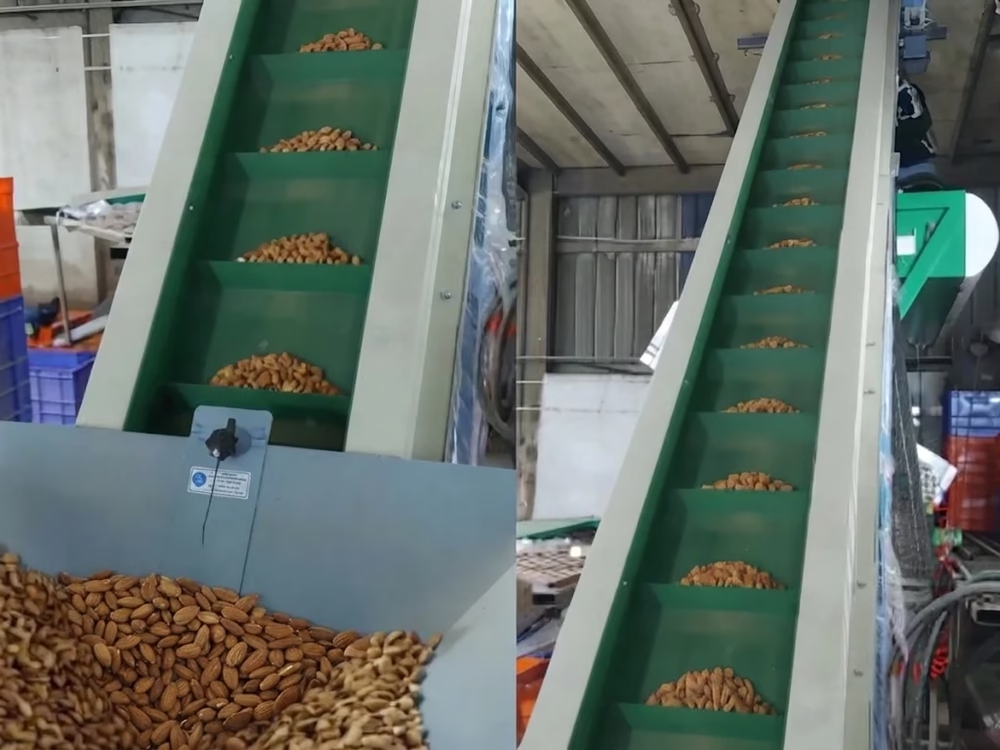
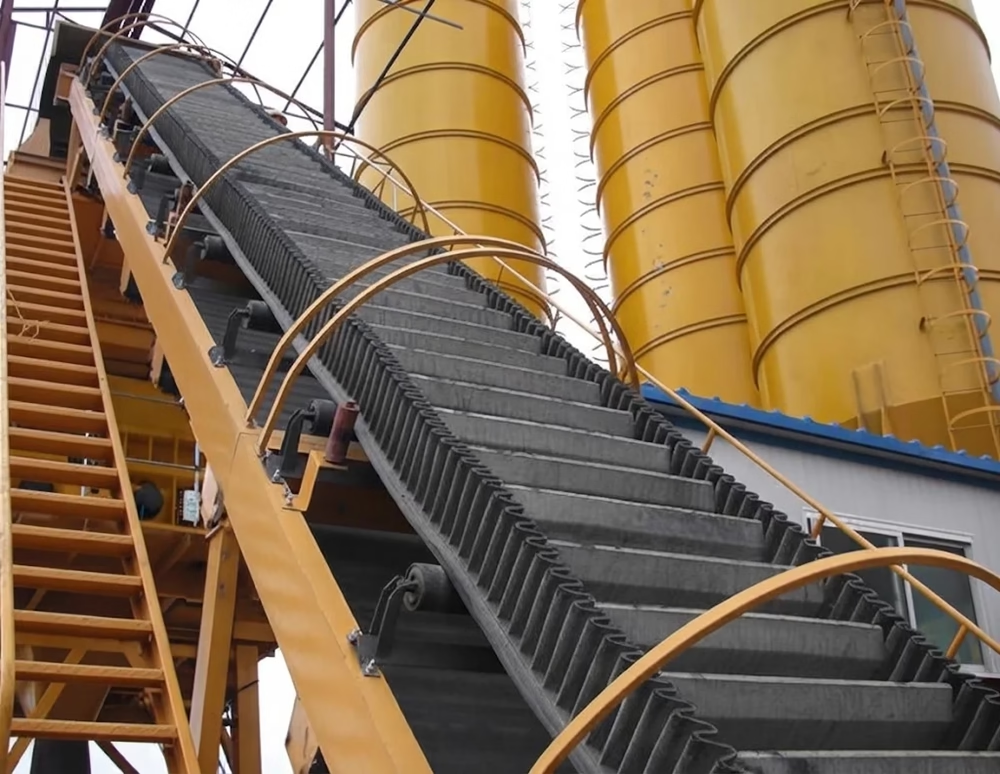
Cleated belts can also incorporate sidewalls, so these categories overlap. The complete belt construction determines how the system should be classified and selected.
When a plain belt cannot retain material reliably, a profiled or cleated belt may be appropriate. As the conveying angle increases, or when lateral spillage must be controlled, a corrugated sidewall belt is often a better fit.
How to Select the Conveying Angle for Your Site
In sidewall belt conveyor design, the conveying angle depends on the required lift height and the horizontal space available for the inclined section. For a given lift height, a shorter horizontal distance requires a steeper angle.
The conveying angle can be calculated as follows: θ = arctan(H / L)
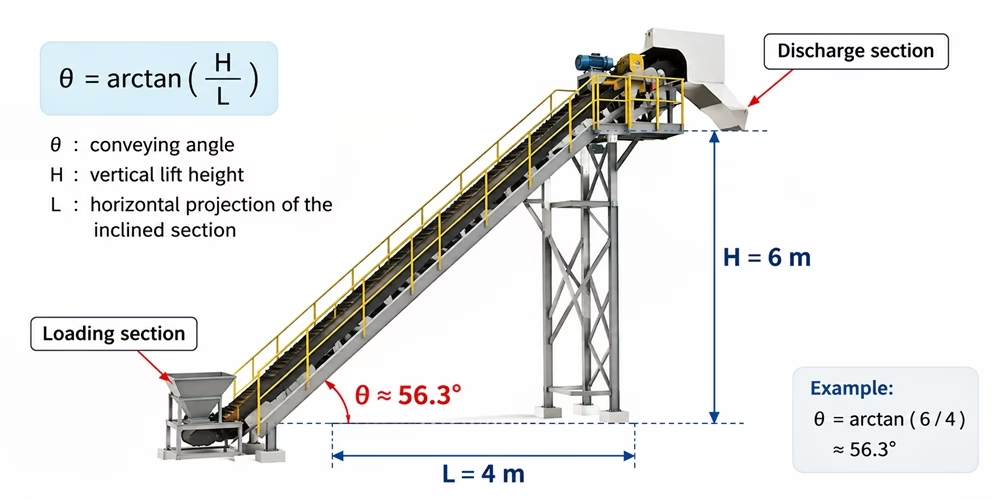
Where:
- θ = conveying angle
- H = vertical lift height
- L = horizontal projection of the inclined section
For example, an aggregate production line needs to lift material by 6 m, and the inclined section has a horizontal projection of 4 m, excluding the horizontal loading and discharge sections.
θ = arctan(6 / 4) ≈ 56.3°
The inclined conveying section therefore requires an angle of approximately 56.3°. The design must also allow space for loading, discharge, transition sections, and maintenance. The site’s total available horizontal length should not be substituted directly for L.
Once a preliminary angle has been established, check the following factors:
- Particle size: Large lumps need sufficient pocket space to avoid jamming or obstructing discharge.
- Material characteristics: High-density materials increase the load on the cleats. Wet or sticky materials require attention to buildup and material remaining after discharge.
- Conveying capacity: Match sidewall height, cleat configuration, and belt speed to the required throughput.
- Installation layout: Check inlet and outlet positions, transition sections, and maintenance access to confirm that the complete conveyor fits the site.
A steeper angle is not always better. Although it reduces the horizontal footprint, it places greater demands on pocket configuration, stable loading, and discharge design. The final angle should reflect the available space, material characteristics, and target throughput, rather than the conveyor’s stated maximum angle alone.
If you are unsure which angle suits your project, provide the material name, lift height, target throughput, and installation dimensions. GUOFENG can help calculate and determine a suitable conveying arrangement.
How to Select Sidewall Height and Cleat Configuration
Sidewall height and cleat configuration are important factors in sidewall belt conveyor design. The sidewalls contain material at the belt edges, while the cleats support it and reduce rollback on steep inclines. Both components must be matched to the material and required capacity.
How to Choose Corrugated Sidewall Height
Corrugated sidewall height affects the space available within each material pocket, but taller sidewalls are not always the best choice. Consider three main factors:
- Particle size: Large lumps need enough loading space to avoid becoming trapped between the sidewalls and cleats.
- Loading depth: The sidewalls should extend above the normal material loading depth, with an appropriate margin to reduce lateral spillage during operation.
- Conveying capacity: Taller sidewalls can increase the available loading space, but actual throughput also depends on the effective loading width, cleat dimensions, and pocket fill.
Frequent spillage over the sides does not necessarily mean the sidewalls are too low. Excessive feeding or an unsuitable loading position may also be responsible.
How to Select Cleat Height, Shape, and Spacing
Cleats support the material and prevent it from sliding down the inclined belt. Conveyor belt cleat design should address four factors:
Cleat height
This determines the height over which material is supported and affects the available loading space. As the incline becomes steeper, check that the cleats can hold the material securely.
Cleat shape
Common configurations include T-type and C-type cleats. Their material support and discharge characteristics differ, so the choice should suit the material and conveying angle.
Cleat spacing
Excessive spacing may allow material to roll back, while spacing that is too close may restrict the amount loaded into each pocket. Balance pocket space with material stability.
Cleat strength
For large lumps of ore, iron ore, and other heavy or abrasive materials, select cleats with sufficient strength to resist bending or cracking during prolonged operation.
How Should the Base Belt and Sidewall Assembly Be Matched?
Base belt selection involves more than material weight. Belt width and the way the sidewalls and cleats are attached also need attention. The total belt width is not the same as the effective loading width. Capacity calculations should use the usable width between the sidewalls.
The sidewalls and cleats must also be securely attached to the base belt to reduce the risk of cracking or separation over time.
For L-shaped, Z-shaped, and other conveyor layouts with transition sections, check the bend radius and pulley dimensions. An excessively small bend radius can overflex the sidewalls and damage the cleat attachment areas. Matching the belt to the transition geometry is particularly important with taller sidewalls and larger cleats.
How to Calculate Sidewall Belt Conveyor Capacity
Capacity calculation is an important part of sidewall belt conveyor design. The estimated throughput depends on the average material load per pocket and the number of pockets passing a given point per hour.
Which Parameters Determine Conveying Capacity?
| Parameter | Effect on capacity |
|---|---|
| Effective loading width | Determines the width available for material within each pocket. |
| Sidewall height | Affects the available material containment space along the sides of each pocket. |
| Cleat spacing | Determines the pocket length between adjacent cleats. |
| Belt speed | Determines how many pockets pass a given point per hour. |
| Material bulk density | Affects the mass of material carried in each pocket. |
The actual amount loaded into a pocket is not the same as its maximum volumetric capacity. At steeper angles, material stability and the actual pocket fill require particular attention.
What Is the Sidewall Belt Conveyor Capacity Calculation?
A sidewall belt conveyor capacity calculation can use the average material mass per pocket and the number of pockets passing per hour:
Q = (m × v × 3,600) / (p × 1,000)
Where:
- Q = mass throughput in metric tonnes per hour (t/h)
- m = average material mass per pocket in kilograms (kg)
- v = belt speed in metres per second (m/s)
- p = cleat spacing, or pitch, in metres (m)
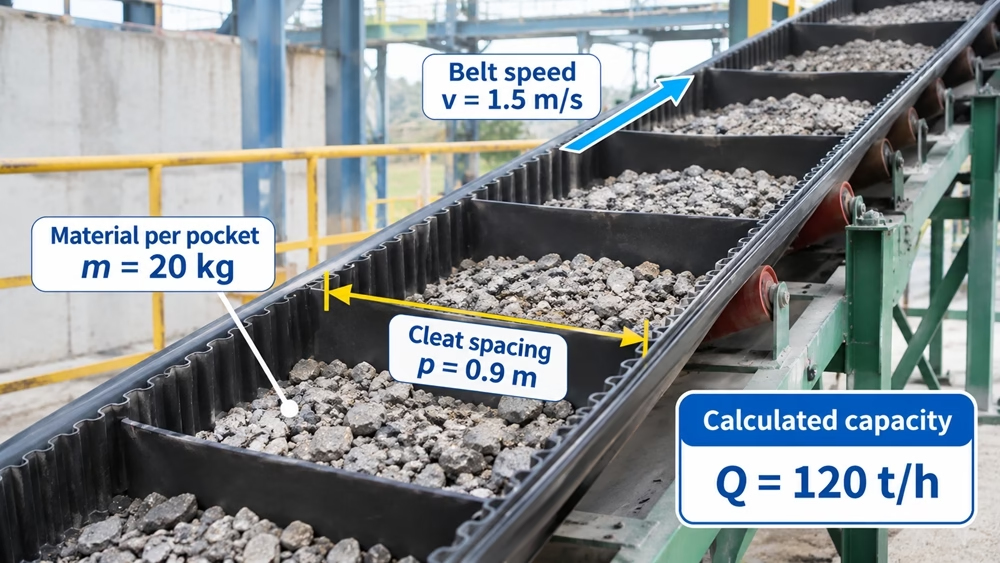
For example, assume the conveyor operates with the following values:
- Average material mass per pocket: 20 kg
- Belt speed: 1.5 m/s
- Cleat spacing: 0.9 m
Step 1: Calculate the number of pockets passing per hour. 1.5 / 0.9 × 3,600 = 6,000 pockets per hour
Step 2: Calculate the hourly mass throughput. 20 × 6,000 / 1,000 = 120 t/h
The estimated throughput is therefore 120 t/h, provided that each pocket consistently carries an average of 20 kg of material.
The 20 kg value is an assumed load for this example only. The actual mass per pocket must be determined from the pocket dimensions, material bulk density, and loading conditions.
Why Can Actual Throughput Be Lower Than the Calculated Value?
Actual throughput can vary even when conveyor dimensions and belt speed are the same. Common reasons include:
- Insufficient feeding: An intermittent material supply leaves some pockets underfilled.
- Material rollback: A steep incline or unsuitable cleat configuration prevents material from remaining securely in the pockets.
- Material buildup: Wet or sticky material adheres to the belt and cleats, affecting loading and discharge.
- Changes in operating speed: The actual belt speed is lower than the speed used in the calculation.
Capacity calculation is only the first step in equipment selection. After establishing the target throughput, check drive power, belt strength, and cleat load capacity to confirm that the conveyor can operate continuously and reliably under actual conditions. For additional guidance on bulk material conveyor engineering, refer to the CEMA Standards & Technical Publications, including Belt Conveyors for Bulk Materials.
How to Select a Sidewall Belt Conveyor for Different Materials
Material characteristics directly affect sidewall belt conveyor design. Crushed stone requires attention to abrasion and impact, wet sand can adhere to the belt, and iron ore places greater loads on the cleats and base belt. The belt construction should be selected according to these operating conditions.
| Material | Common issues | Selection considerations |
|---|---|---|
| Crushed stone | Impact from large lumps and abrasion from sharp edges | Select an abrasion-resistant base belt and check cleat strength and pocket dimensions. |
| Sand | Wet sand may adhere to the belt and interfere with discharge | Choose a pocket configuration suited to the moisture content and consider material remaining after discharge. |
| Coal | Wide variations in lump size and spillage of fine particles | Size the pockets for the maximum particle size and address spillage prevention and dust control. |
| Iron ore | High bulk density and substantial abrasion | Check the base belt’s load-carrying capacity, cleat strength, and abrasion resistance. |
| Cement and powders | Dust generation and, for some materials, adhesion | Address inlet and outlet sealing, dust control, and discharge design. |
What Information Is Needed Before Selecting a Conveyor?
For sidewall belt conveyor design, provide the material name, maximum particle size, bulk density, moisture content, and required throughput. Also identify any tendency to stick, cause abrasion, or vary significantly in particle size.
Common Sidewall Belt Conveyor Problems and Solutions
Common problems in sidewall belt conveyor design and operation include material spillage, rollback, incomplete discharge, and belt mistracking. Start by checking the feeding arrangement, cleat condition, and belt operation.
| Common problem | Possible causes | Recommended action |
|---|---|---|
| Material spills over the sides | Excessive feeding, unsuitable loading position, or insufficient sidewall height | Adjust the feed rate and loading position, and check whether the sidewall height is appropriate. |
| Material slides backward | Unsuitable cleat configuration or overloading | Check cleat height, cleat spacing, and the actual load per pocket. |
| Incomplete discharge | Damp material adheres inside the pockets | Check the discharge arrangement and fit a suitable cleaning device if needed. |
| Belt mistracking | Poor pulley alignment, incorrect tension, or off-centre feeding | Check the pulleys, tensioning system, and loading position. |
| Cleats deform or crack | High material impact, excessive loads, or damaged attachment areas | Check feeding conditions, cleat strength, and attachment areas. |
| Sidewalls crack or separate from the belt | Damaged attachment areas, prolonged wear, or unsuitable transition geometry | Check the sidewall attachments, bend radius, and compatibility with the pulleys. |
If the same problem keeps recurring, avoid simply increasing belt speed or feed rate. Identify the cause first, then adjust the operating parameters or relevant components.
FAQ
1. Can a Sidewall Belt Conveyor Handle Wet or Sticky Materials?
Yes. However, wet or sticky materials can adhere to the belt and cleats, leaving material behind after discharge. Selection should account for moisture content, adhesion, and the discharge method. A cleaning device may be needed.
2. Can a Sidewall Belt Conveyor Convey Material Vertically at 90°?
Yes. With suitable corrugated sidewalls and cleats, some systems can operate as a vertical sidewall belt conveyor at 90°. Whether a vertical layout is suitable for a particular project still depends on particle size, material flowability, and pocket configuration.
3. What Should I Check If Conveying Capacity Is Too Low?
First, check whether the feed rate is sufficient, the pockets are adequately filled, and material is rolling back or remaining in the pockets after discharge. Before increasing throughput, confirm that the belt speed, drive power, and cleat load capacity can support the required output.
4. Can a Sidewall Belt Conveyor Be Integrated into an Existing Production Line?
Yes. Confirm the inlet and outlet positions, conveying capacity, and available installation space of the existing equipment in advance. The conveyor layout should then be adapted to the connection dimensions of the upstream and downstream equipment.
5. Does a Higher Belt Speed Always Mean Higher Throughput?
Increasing belt speed raises throughput if the material load per pocket remains unchanged. However, excessive speed can disrupt stable loading and discharge and increase operating loads. Increasing speed alone is therefore not a sufficient approach to raising capacity.
6. Can the Conveyor Be Customized for a Project?
Yes. GUOFENG can adjust the base belt width, sidewall height, cleat configuration, and overall conveyor layout to suit the material characteristics, target throughput, lift height, and installation space. Provide your material information and site dimensions so we can help determine a suitable configuration.
Need help with a similar request?
Share your product requirements, timeline and cooperation goals. We can help clarify the next step.
